
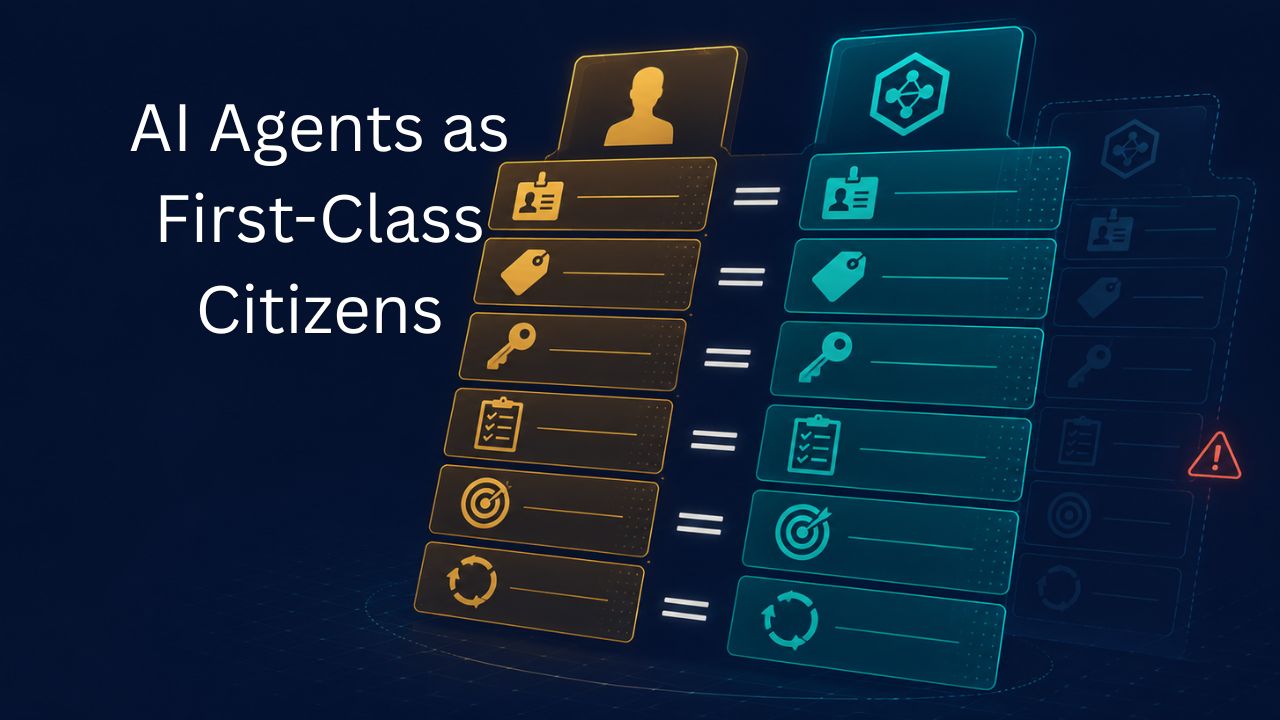
AI Agents as First-Class Citizens#
Why Managing the Digital Workforce Is the Next HR Challenge
When your workforce directory lists people and agents side by side, who owns the second column?
The thesis in one paragraph#
For more than a century, organizations have treated humans as first-class workforce participants and software as tools humans operate. That split made sense when applications only executed fixed instructions.
AI agents break the split. A deployed agent has a name, a role, access to systems, spending authority (in tokens and API calls), measurable output, escalation paths, and owners who are accountable when it errs. The same categories HR has always used for people—identity, role, authority, responsibilities, key result areas (KRAs), and goals—now apply to non-human workers too.
Agents are not employees. They are not passive software either. They form a digital workforce: a new organizational resource that combines characteristics of workers, systems, infrastructure, and intellectual property. If you would not hire an analyst without defining scope, permissions, and success metrics, you should not deploy an agent without the same discipline. Managing the digital workforce is not less critical than managing human resources—and in some ways it is more complicated, because agents can be replicated at scale.
This article is for executives who must decide who governs agents, how they appear on org charts, and what happens when they fail—before shadow agents outnumber shadow IT.
Who this is for#
- CEO, COO, or business unit head planning the next wave of AI adoption
- CHRO or head of people operations facing a hybrid human–agent workforce
- CIO, CTO, or CISO responsible for systems access and audit trails
- CFO or finance leader comparing cost per human task versus cost per agent task
- Board members asking whether AI governance belongs in IT, HR, or a new function
If you have already read Agentic AI for Business Leaders, treat this post as the organizational design layer beneath those workflow patterns. If you lead people functions, pair it with AI for HR and People Leaders—the scenarios there assume humans remain the primary workforce; this post argues that assumption is expiring.
From tools to workforce participants#
Organizations have always managed several resource classes: people, capital, physical assets, information, and technology. Technology was historically passive: it ran what it was told, the same way every time, with no judgment and no seat at the workflow table.
Agents behave differently. They interpret goals, plan actions, use tools, search knowledge bases, collaborate with other agents, interact with humans, produce reports, escalate decisions, and adapt to context. A Capital Call Agent in an investment management firm does not simply execute a fixed workflow—it reviews documents, extracts relevant data, validates details, consults policies, and generates outputs that traditionally required human effort. That resembles a knowledge worker more than a traditional application.
That is not metaphor. It is how work already flows in early-adopter enterprises:
| Resource type | Example participants |
|---|---|
| Human workers | CFO, financial analysts, compliance officers, account managers |
| AI agents | Financial-statement agent, capital-call agent, investor-reporting agent, regulatory-compliance agent, client-communication agent |
Work is allocated across both columns. Budget, access, and accountability follow the work—not the biology of the worker. At that point, software inventory and workforce inventory overlap, and treating agents as unnamed scripts in a cloud bill is a governance failure waiting for a headline.
Agent definition vs agent instance#
One concept most AI discussions skip—and every executive will need—is the distinction between an Agent Definition and an Agent Instance.
A human employee is both the design and the worker. A financial analyst is the person; there is no separate template you can clone. Scaling requires hiring, training, onboarding, and management.
An AI agent has two forms:
Agent Definition — the job description, capability blueprint, or digital DNA. Example: a Capital Call Agent definition specifies capabilities (document analysis, extraction, validation, reporting), knowledge sources (policies, procedures, historical data), and tools (OCR, databases, LLMs). The definition may exist only once in the registry.
Agent Instance — a running worker created from that definition. One Capital Call Agent definition may spawn one instance for Fund A, one for Fund B, a hundred during month-end close, or a thousand at peak load. Instances come and go; the definition persists and evolves.
This separation is one of the most powerful characteristics of the digital workforce—and one of the hardest for organizations built around headcount to absorb.
Why agent economics change organizational scale#
Organizations scale humans through an expensive chain: recruit, train, supervise, retain. Each employee develops skills individually, improves individually, and introduces variability individually.
Agents scale differently. You improve the Agent Definition once; every future instance inherits the improvement. If a Capital Call Agent moves from 92% to 98% accuracy, thousands of future instances benefit immediately. There is no equivalent mechanism in human organizations.
That changes growth economics, productivity planning, and org design. It also changes what managers supervise—which leads to the hybrid org chart below.
The management parallel that executives already understand#
HR systems exist because humans are not interchangeable blobs of capacity. Each employee has attributes leaders must track. Agents carry the same attribute classes. The vocabulary differs; the management obligation does not.
| Attribute | Human workforce | AI agent workforce |
|---|---|---|
| Identity | Name, employee ID, department | Agent name, agent ID, version, category |
| Role | Job title, level, function | Agent type (research, draft, monitor, workflow), domain |
| Authority | Approval limits, signing rights, delegation | Tool access, auto-send rules, spend caps, escalation thresholds |
| Responsibilities | Job description, RACI assignments | Supported tasks, allowed data sources, output types |
| KRAs / goals | Quarterly objectives, KPIs | Accuracy targets, latency SLAs, cost per task, throughput |
| Skills / competencies | Skills matrix, certifications | Capabilities: extraction, validation, summarization, coding, planning |
| Knowledge | Training, tenure, documentation read | Knowledge bases, fine-tuning, RAG corpora, SOPs, policies ingested |
| Access rights | IAM roles, badge, VPN | Database, CRM, ERP, email, API scopes, service account access |
| Performance | Reviews, ratings, calibration | Scorecards: hallucination rate, error rate, user satisfaction |
| Cost | Salary, benefits, overhead | Model, inference, storage, monitoring, maintenance |
| Reporting line | Manager, skip-level | Owner, supervisor agent, human approver |
| Lifecycle | Hire, promote, transfer, exit | Provision, version, monitor, retire, decommission |
When CHROs maintain competency matrices and IAM teams maintain role-based access for people, the same two disciplines must converge for agents. An agent without scoped authority is as dangerous as an employee with excessive permissions—and often harder to detect because it does not appear in the headcount report.
Lineage, hierarchy, and the org chart of the future#
Today an operations manager might supervise Analyst A, Analyst B, and Analyst C. Tomorrow the same manager might supervise Analyst A, Analyst B, a Capital Call Agent definition, an Audit Evidence Agent definition, and a Tax Reporting Agent definition—with hundreds or thousands of active instances spun up from those definitions during peak periods.
The manager is not supervising thousands of individual agent workers. The manager is supervising capabilities—the definitions from which those workers are created—while validating outputs, setting policies, and ensuring quality. That is a new kind of work: managing intelligence rather than executing work.
Humans belong to families and reporting trees. Agents belong to development lineages and orchestration hierarchies:
AIB Supervisor Agent
└── Reporting Agent
    ├── Financial Statement Agent
    ├── NAV Agent
    └── Tax Agent
Organizations that deploy dozens of agent types will need agent family trees alongside human org charts: which agent reports to which supervisor agent, which human owns production behavior, and which compliance officer attests to regulatory agents. The question “who does this agent report to?” is already an audit question in regulated industries—not a thought experiment.
Why “IT asset management” is the wrong frame#
Most enterprises today catalog agents—if they catalog them at all—as applications or API integrations. That frame hides the attributes in the table above and creates predictable failures:
- Shadow agents proliferate when business units spin up tools without registry entries, owners, or retirement dates.
- Access sprawl grows when every agent inherits broad database or email permissions “to be useful.”
- Accountability gaps appear when an agent sends incorrect investor data and no one can name the responsible owner.
- Cost opacity hides in cloud invoices until finance discovers duplicate agents performing the same task at different price points.
- Version drift leaves deprecated agents running beside current ones, like employees never offboarded.
Software asset management asks: What do we run? Workforce management asks: Who does what, with what authority, toward which goals, under whose supervision? Agents require the second question.
The Agent Registry: tomorrow’s HR system for non-human workers#
Mature organizations maintain HRMS, payroll, and employee directories. The equivalent for agents is an Agent Registry—not a spreadsheet maintained by one enthusiastic engineer, but an enterprise system of record.
| Registry domain | What it must capture |
|---|---|
| Identity | Name, version, owner, business unit, domain |
| Role and scope | Supported tasks, prohibited actions, human-in-the-loop requirements |
| Authority | Systems, APIs, data classes, auto-execution rules |
| Ownership | Business owner, technical owner, agent steward |
| KRAs / goals | Accuracy, cost, latency, volume targets |
| Performance | Live scorecards, trust score, incident history, user feedback |
| Governance | Compliance classification, security tier, audit log retention |
| Economics | Monthly spend, cost per task, comparison to human baseline |
| Lifecycle | Provision date, last update, planned retirement |
A modern workforce directory may soon look like this:
| Resource type | Count |
|---|---|
| Human employees | 5,000 |
| Contractors | 700 |
| AI agent definitions | 1,200 |
| Active agent instances (peak) | 50,000+ |
| Automated workflows (non-agent) | 3,500 |
That ratio is not science fiction. Large enterprises are already approaching it in pockets—customer operations, software delivery, finance close, security operations—without a unified registry. The gap between deployed agents and governed agents is the risk.
Digital Workforce Management and the Agent Steward#
As organizations deploy hundreds of agent types and potentially millions of instances, a new management discipline will emerge—call it Digital Workforce Management (DWM). It will not belong to HR alone, IT alone, or Operations alone. It will span:
| DWM domain | Responsibilities |
|---|---|
| Lifecycle | Create, deploy, monitor, improve, retire definitions and instances |
| Governance | Security, compliance, auditability, accountability |
| Performance | Accuracy, reliability, cost, quality scorecards |
| Economics | Cost per task, cost per workflow, return on investment |
| Evolution | Feedback collection, fine-tuning, retraining, capability expansion |
Many executives instinctively imagine an “Agent Manager.” A better concept is an Agent Steward. Managers supervise people; stewards oversee capabilities. An Agent Steward is responsible for capability quality, compliance, performance, cost effectiveness, and continuous improvement—working with project managers, operations leaders, HR, IT, and compliance teams to keep agents useful, trustworthy, and aligned with business objectives.
The hybrid organization: human, digital, and platform#
The future enterprise coordinates three layers, not two:
| Layer | What it provides |
|---|---|
| Human workforce | Leadership, judgment, accountability, relationships |
| Digital workforce | Analysis, execution, monitoring, scale |
| Platform workforce | Agent registries, governance systems, monitoring, deployment platforms |
The most successful organizations will learn to coordinate all three. Many discussions about AI focus on models, prompts, and technology stacks. Those matter—but the deeper challenge is management: how to govern a workforce that can be replicated infinitely, measure its performance, assign accountability, control costs, and improve capabilities over time. Those are organizational questions, not engineering tickets.
New questions for the leadership team#
Agent adoption forces questions HR and IT have never had to answer together:
| Domain | Question |
|---|---|
| Workforce planning | How many agent definitions do we need by function, and which human roles shrink, shift, or grow? |
| Organizational design | Which definitions sit under which managers—or supervisor agents? |
| Budgeting | Which cost center funds an agent shared across departments? |
| Authority | Who approves an agent’s ability to act without a human click? |
| Accountability | When an agent errs, is the owner the developer, the product owner, the steward, or the business sponsor? |
| Audit | Can we reconstruct what the agent knew and did at decision time? |
| Retirement | When is a definition obsolete, unsafe, or too expensive to keep running? |
These are board-level governance questions, not backlog grooming. They belong in the same conversation as headcount planning—not in a late-night Slack thread after a demo impresses the executive team.
Three stages of evolution—and where most companies stall#
| Stage | Examples | Behavior |
|---|---|---|
| 1. Tool | Spreadsheet, email, database | Human operates directly |
| 2. Automation | Workflow engine, RPA, scripts | Predefined tasks, no reasoning |
| 3. Agent | Research, draft, monitor, workflow agents | Reasoning, planning, collaboration, conditional autonomy |
The jump from Stage 2 to Stage 3 is as significant as the move from paper files to ERP. Many organizations are deploying Stage 3 workers with Stage 1 governance: no owner, no KRA, no retirement plan, no steward. That mismatch is the core executive risk this article describes.
Economics: cost per task and management leverage#
Finance already models fully loaded cost per human FTE. Agents introduce parallel metrics: cost per agent task and cost per workflow (inference, orchestration, storage, monitoring, human review time).
Executives will increasingly compare:
- Cost and cycle time for a human-prepared quarterly investor pack versus an agent-assisted pack with human sign-off
- Error rates and rework cost across both paths
- Whether duplicate agent definitions in different departments should consolidate into one governed definition
AI also changes management leverage. Historically, a manager could supervise only a limited number of people. One professional may eventually oversee multiple agent definitions, hundreds of active instances, and thousands of automated tasks—setting policies and validating outputs rather than performing every step. This is not about replacing humans on a spreadsheet. It is about allocating hybrid capacity the same way leaders already allocate headcount and capital—with transparent unit economics.
What executives should do in the next 90 days#
You do not need a perfect Agent Registry on day one. You do need executive ownership of the problem.
- Name a sponsor. Assign a single executive owner for digital workforce governance (often COO, CIO, or a dedicated AI lead)—not a diffuse “AI committee” with no authority.
- Inventory what is already running. Discover shadow agents before regulators or customers do. Minimum fields: owner, steward, role, systems accessed, business purpose, definition vs instance.
- Adopt the human-attribute checklist. For every production agent definition, require identity, role, authority limits, responsibilities, KRAs, and a retirement trigger—mirroring what you would require for a new hire requisition.
- Draw authority boundaries. Document which actions require human approval, which are logged-only, and which are prohibited—same discipline as delegation of authority policies for people.
- Pilot an Agent Registry. Start with one business unit; link it to IAM and finance tags so access and cost are visible together.
- Align HR, IT, legal, and operations. CHRO owns workforce metaphors and policy language; CISO owns access and audit; legal owns liability and regulatory mapping; operations owns stewards and capability quality. Digital Workforce Management is a shared function, not an engineering side project.
Conclusion: Human Resources is no longer the only workforce function#
For decades, software was a tool and people were the workforce. AI agents occupy a third category: workforce participants implemented in software—neither employees nor passive assets. They have identity, roles, authority, responsibilities, KRAs, goals, costs, stewards, and lifecycles—or they should.
Organizations that recognize this early will not merely automate tasks. They will redesign the enterprise around a hybrid system where humans, digital workers, and governing platforms operate together—where agents are first-class organizational citizens, governed, measured, and accountable.
Human Resource Management transformed organizations in the twentieth century. Digital Workforce Management may become one of the defining disciplines of the twenty-first. The companies that thrive will not be those that merely deploy AI. They will be those that learn how to build, govern, measure, and scale a digital workforce alongside their human workforce—with the same seriousness they have always applied to the people who built the company.
Related reading#
- Agentic AI for Business Leaders — four agent patterns, guardrails, and workflow design
- AI for HR and People Leaders — workforce planning and people scenarios with AI
- Leaders, Human Skills, and AI: What Stays Yours — series frame on accountability and judgment
- The AI Leadership Playbook — capstone workbook for leader-specific AI use

Comments: