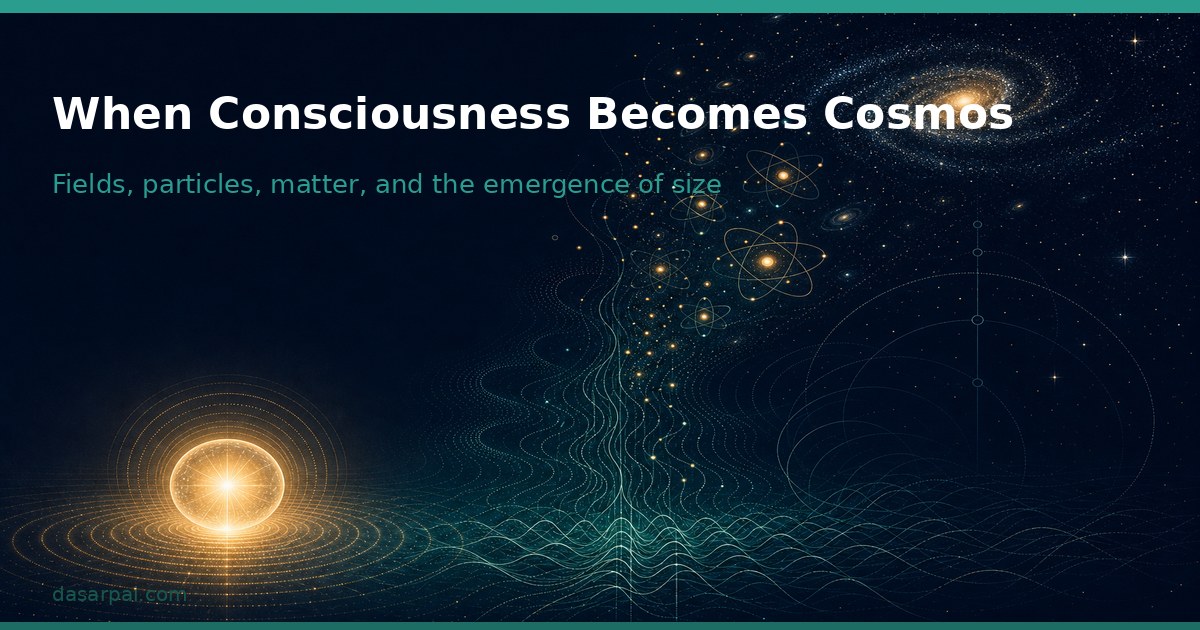
When Consciousness Becomes Cosmos#
From Consciousness to Cosmos: Fields, Particles, Matter, and the Emergence of Size
Introduction: From Objects to Fields#
In everyday life, we experience the world as objects.
A stone has weight. A mango has color, taste, smell, and shape. A human body has size, temperature, movement, and life. A planet has mass, orbit, and gravity.
In ordinary experience, object and property appear together, but our language often separates them: we say “the mango is yellow,” “the stone is heavy,” “the flame is hot.” This gives us the impression that there is a thing underneath and properties belonging to it. Properties do not hang in empty space. Redness belongs to a flower. Sweetness belongs to sugar. Temprature and Weight belongs to a body.
Modern physics slowly dissolves this simple object-based picture.
At the deepest level known to current physics, the world is not made of tiny hard balls. It is described in terms of fields. Particles are not independent little marbles floating in space. They are better understood as excitations of underlying fields.
An electron is an excitation of the electron field. A photon is an excitation of the electromagnetic field. A quark is an excitation of a quark field. A Higgs boson is an excitation of the Higgs field.
This changes the question completely.
Instead of asking:
What is the object made of?
we begin to ask:
What field is expressing itself here? What state is that field in? What properties arise from that state? How do stable structures emerge from field interactions?
And if we go one step deeper, into philosophy and spirituality, we may ask:
Are fields themselves the final reality? Or are fields also expressions of something still deeper — perhaps consciousness?
This article explores that bridge carefully. It will respect modern physics, but it will also open the philosophical possibility that consciousness may be the ultimate unifying ground. That part is not settled science. It is a contemplative and metaphysical possibility.
1. The Classical View: Objects and Properties#
Classical thinking begins with objects.
A ball has mass. A table has size. A flame has heat. A magnet has magnetic power.
In this view, matter is primary and properties belong to matter.
This is how human perception works. Our senses evolved to help us survive in a world of medium-sized objects: stones, trees, animals, rivers, tools, food, fire, and people.
But when we go to the microscopic level, this object-based view becomes weaker.
An atom is mostly empty space. An electron is not a tiny solid sphere. A proton is not a simple ball. Light behaves both like wave and particle. Matter and energy transform into one another. Particles appear and disappear in interactions.
So physics gradually moved from object ontology to field ontology.
That means:
The field is more fundamental than the particle. The particle is a special state of the field.
2. The Quantum Field View: Fields Are Fundamental#
In quantum field theory, a field is not merely a mathematical convenience. It is treated as the basic physical reality.
A field exists throughout space-time. It can be in different states. Some states are low-energy states. Some are excited states. Some excitations are stable and countable. We call those stable excitations particles.
So the hierarchy becomes:
Field
→ state of field
→ energy/momentum/probability structure
→ excitation
→ particle
→ interaction
→ matter, force => atoms => molecules => bodies
This is very different from the ordinary picture.
In ordinary thinking:
Particle → has properties
In quantum field thinking:
Field → state → particle-like excitation → measurable properties
A particle does not first exist as a blank object and then acquire mass, charge, spin, and energy. Rather, its properties arise from the nature of the field and its interactions.
An electron is not a small ball that has been given charge. Being an electron already means being an excitation of the electron field with electron charge, electron spin, electron mass, and electron-like behavior.
3. Field and Energy: Which Is More Fundamental?#
A common phrase says: “Everything is energy.”
This is poetic, but scientifically imprecise.
In modern physics, energy is not usually treated as a separate substance. Energy is a property of the state of a physical system.
So it is better to say:
Fields are more fundamental. Energy is a property of field states.
For example, the electromagnetic field can be in a vacuum state, a low-energy light state, or a high-energy gamma-ray state. The field is the underlying system. Energy describes the condition or configuration of that field.
Similarly, the electron field may have no electron excitation in a region, or it may have one electron excitation. The excited state has energy. The energy is not floating separately from the field.
Thus:
Field → field state → energy as property of that state
Energy does not hang in the sky without a field or system. Just as color belongs to a colored object, energy belongs to a field configuration or physical state.
4. Field and Possibility: The Role of Quantum Uncertainty#
A quantum field is not like a classical object that has all its properties sharply fixed.
In quantum theory, the state of a system contains probabilities or possibilities for measurement outcomes. This does not mean the field is “made of imagination.” It means the field state is described by probability amplitudes.
For a particle, position and momentum cannot both be perfectly definite.
For a field, the field value and its rate of change cannot both be perfectly fixed everywhere.
This is why even the lowest-energy state of a quantum field is not like a dead, frozen nothing. It has quantum structure. It has unavoidable uncertainty.
But we must be careful.
Uncertainty is not another substance. Possibility is not another material. Probability is not energy.
Rather:
Possibility is built into the quantum description of the field state.
So the field has states, those states have energy, and those states also contain a probability structure.
4.1 Information and Energy#
Another common phrase says: “Information is energy.” Some even add that, like energy, information is never ultimately created or destroyed.
This is evocative, but it must be handled carefully.
In physics, information usually means pattern, distinguishability, or structure in a physical state: which configuration a system is in, which symbol was sent, which base pair appears in DNA. It is not the same thing as energy. Energy is a property of a field state or system. Information describes how that state is organized or which possibility is realized.
Yet the two are not unrelated. Erasing or resetting information has an energy cost (Landauer’s principle). In black hole physics, information, entropy, and energy are linked in deep and still-debated ways. In many closed quantum systems, the evolution of a state preserves information in a manner analogous to conservation laws — though this is not the same as energy conservation in the strict physical sense.
So a safer scientific statement is:
A field state has energy, and it may also have informational structure. The two are related, but not simply identical.
The stronger claim that information is energy, or that information can never be lost in any ultimate sense, belongs partly to philosophy and partly to unsettled physics. It should not be stated as settled fact. We return to the deeper distinction between information, intelligence, and consciousness in section 14.4.
5. Types of Fundamental Fields#
In the Standard Model of particle physics, there are several kinds of fields.
For simplicity, we can group them into three broad families:
- Matter fields
- Force fields
- Higgs field
5.1 Matter Fields#
Matter fields give rise to matter particles.
Examples include:
| Matter field | Particle excitation |
|---|---|
| Electron field | Electron |
| Up quark field | Up quark |
| Down quark field | Down quark |
| Neutrino fields | Neutrinos |
| Muon field | Muon |
| Tau field | Tau particle |
Matter fields produce the particles that later combine into atoms and material objects.
5.2 Force Fields#
Force fields give rise to force-carrying particles.
| Force field | Particle excitation | Role |
|---|---|---|
| Electromagnetic field | Photon | Light, electricity, magnetism, chemistry |
| Gluon field | Gluon | Strong nuclear force, quark binding |
| Weak field | W and Z bosons | Radioactive decay, particle transformation |
The force fields do not merely create particles; they govern interactions.
The electromagnetic field allows charged particles to attract, repel, absorb light, emit light, and form atoms and molecules.
The gluon field binds quarks together into protons and neutrons.
The weak field allows certain particles to transform into other particles.
5.3 Higgs Field#
The Higgs field is special.
It is not a force field in the ordinary sense. It has a nonzero background value throughout space. Many elementary particles acquire rest mass through their interaction with the Higgs field.
The electron has mass because the electron field couples to the Higgs field.
Quarks also get their bare masses through the Higgs field.
The W and Z bosons get mass through the Higgs mechanism.
But the photon does not acquire rest mass from the Higgs field. That is why light can travel at the speed of light and the electromagnetic force has long range.
6. How Mass Appears#
Mass is one of the most misunderstood properties.
In ordinary life, mass feels like “amount of stuff.” But in modern physics, mass is connected with energy, inertia, field interaction, and binding.
There are two major sources of mass.
6.1 Elementary Particle Mass#
For elementary particles like electrons and quarks, mass comes from interaction with the Higgs field.
The stronger the coupling with the Higgs field, the heavier the particle.
The top quark couples strongly to the Higgs field and is very heavy. The electron couples weakly and is light. The photon does not get rest mass through this mechanism.
So:
Matter field + Higgs field interaction → elementary rest mass
6.2 Composite Particle Mass#
But most of the mass of ordinary matter does not come directly from the Higgs field.
A proton is made of quarks, but the sum of the quark masses is only a small part of the proton’s mass. Most of the proton’s mass comes from the energy of quarks and gluons bound by the strong force.
This is extremely important.
Your body is made of atoms. Atoms contain nuclei. Nuclei contain protons and neutrons. Protons and neutrons get most of their mass from strong-force binding energy.
So most of the mass of ordinary matter is actually field energy inside bound systems.
7. How Charge Appears#
Electric charge is not painted onto a particle later. It is built into how the field interacts with the electromagnetic field.
The electron field has negative electric charge. The up quark field has charge +2/3. The down quark field has charge -1/3. The photon has zero electric charge.
A proton has charge +1 because it contains two up quarks and one down quark:
+2/3 + 2/3 - 1/3 = +1
A neutron has zero overall charge because it contains one up quark and two down quarks:
+2/3 - 1/3 - 1/3 = 0
So for elementary particles, charge comes from the identity of the field.
For composite particles, charge comes from the sum of internal charges.
8. How Spin Appears#
Spin is another fundamental property.
But spin does not mean the particle is literally rotating like a planet or a ball. It is intrinsic quantum angular momentum.
Different fields have different spin structures.
| Particle | Spin |
|---|---|
| Electron | 1/2 |
| Quark | 1/2 |
| Photon | 1 |
| Gluon | 1 |
| Higgs boson | 0 |
Spin comes from the mathematical nature of the field.
What does 1/2 mean for an electron?
The number is the magnitude of intrinsic angular momentum, measured in natural units where ħ (h-bar) is the unit. An electron always carries spin angular momentum of exactly ½ħ. It never has spin 0, spin 1, or any other value. This is fixed by the type of field it is.
When we measure spin along any chosen direction — up/down, left/right, or any axis — the outcome is always one of two values: +½ or −½. We often call these “spin up” and “spin down.” There is no in-between value. This two-valuedness is the practical signature of half-integer spin.
Why half-integer? In quantum theory, spin is tied to how the field behaves under rotation. Fields with integer spin (like the photon, spin 1) return to the same state after a 360° rotation. But the electron field is different. It is a spinor field. A full 360° rotation does not bring it back to itself. It takes 720° of rotation for the electron field to return to its original quantum state. This strange rotational behavior is what mathematically defines spin ½.
The consequences are enormous. Particles with half-integer spin are called fermions. They obey the Pauli exclusion principle: no two identical fermions can occupy the same quantum state at once. Because electrons are spin-½ fermions, only two electrons can occupy each orbital in an atom — and they must have opposite spins. This rule shapes the entire structure of chemistry, the periodic table, and the stability of matter.
A concrete example helps. A nitrogen atom has 7 electrons. They do not simply pile into two shells with a rough balance of up and down spins. They fill orbitals, and pairing applies per orbital, not per shell.
In the first shell, there is only one orbital, 1s. It holds 2 electrons with opposite spin:
1s: ↑↓
In the second shell, there are several orbitals: one 2s orbital and three 2p orbitals (p_x, p_y, p_z). Nitrogen’s ground-state configuration is 1s² 2s² 2p³:
1s:  ↑↓
2s:  ↑↓
2p:  ↑   ↑   ↑
The two electrons in 2s form a pair with opposite spins. The three electrons in 2p do not all share one orbital. By Hund’s rule, they spread into separate p orbitals with the same spin before any pairing begins. So nitrogen has three unpaired electrons, not “three up and two down” in the second shell.
Compare oxygen with 8 electrons: 1s² 2s² 2p⁴. The fourth 2p electron must pair in one of the p orbitals:
1s:  ↑↓
2s:  ↑↓
2p:  ↑↓  ↑   ↑
Spin pairing is always about which orbital an electron occupies, not about balancing up and down spins across a whole shell.
So again, the particle does not acquire spin from outside. The spin belongs to the type of field excitation it is.
9. From Fields to Particles#
A particle is a stable, countable excitation of a field.
But not every field disturbance is a neat particle. In extreme conditions, such as the very early universe, the particle idea may not be clean. The field state may be too hot, dense, or rapidly changing.
Particles become well-defined when conditions allow stable excitations.
A simplified sequence is:
Quantum fields
→ field states
→ excitations
→ stable excitations
→ particles
Examples:
| Field | Stable excitation |
|---|---|
| Electron field | Electron |
| Electromagnetic field | Photon |
| Quark field | Quark |
| Higgs field | Higgs boson |
Thus, particles are not the deepest reality. They are appearances of field behavior.
10. From Particles to Atoms#
Once particles exist, stable structures can form. In the emergence of a massful world, this unfolded in stages — both in the structure of matter and in the history of the cosmos.
First, quarks bind through the strong force to form protons and neutrons.
Quarks + gluons → protons and neutrons
In the very early universe, fields were too hot and dense for particles to stand out cleanly. As space expanded and cooled, quarks and gluons became distinct excitations and then bound into protons and neutrons. Electrons, neutrinos, and photons also became well-defined in this cooling process.
Then protons and neutrons form atomic nuclei.
Protons + neutrons → nuclei
Within the first few minutes, nuclear processes in the hot early cosmos produced mostly hydrogen and helium nuclei, with only traces of heavier light nuclei such as lithium.
Then electrons bind to nuclei through electromagnetic attraction.
Nucleus + electrons → atom
Much later, when the universe had cooled enough, electrons could capture nuclei and the first neutral atoms formed — again mainly hydrogen and helium. The richer variety of atoms — carbon, oxygen, nitrogen, iron, and the rest of the periodic table — came later still, forged mainly inside stars through nuclear fusion and spread by stellar explosions. Different elements exist because nuclei contain different numbers of protons; chemistry depends on how many electrons bind around each nucleus.
An atom is not a tiny solar system in the literal sense. Electrons do not orbit the nucleus like planets orbit the Sun. Instead, electrons occupy quantum states around the nucleus. These states form probability clouds.
The size of an atom comes mainly from the structure of the electron cloud.
So atomic size is already an emergent property. It is not a fundamental size of the electron. It arises from electromagnetic interaction, quantum rules, and stable electron states.
11. From Atoms to Molecules#
Atoms combine into molecules through electromagnetic interactions.
Chemical bonding is mainly the result of electron behavior.
Atoms share, donate, receive, or redistribute electrons. This creates molecular structures.
Examples:
Hydrogen + oxygen → water molecule
Carbon + hydrogen + oxygen → organic molecules
Carbon networks → complex biological molecules
At this level, new properties emerge.
Hydrogen is a gas. Oxygen is a gas. Water is liquid at ordinary temperatures.
The wetness of water is not found inside a single hydrogen atom or oxygen atom. It emerges from molecular arrangement and interaction.
This is called emergence.
12. From Molecules to Size, Shape, and Texture#
At the level of elementary particles, size is not simple.
The electron is treated as point-like in the Standard Model. It does not have a known radius like a tiny marble.
But composite things have size.
A proton has size because it is a bound state of quarks and gluons. An atom has size because of its electron cloud. A molecule has size because of atomic arrangement. A crystal has size and shape because atoms repeat in a pattern. A body has size because cells, tissues, organs, and bones organize matter.
So size is mostly an emergent property.
| Level | Source of size |
|---|---|
| Electron | No known classical size; treated as point-like |
| Proton | Bound quark-gluon structure |
| Atom | Electron cloud |
| Molecule | Atomic bonding geometry |
| Material | Molecular/crystal arrangement |
| Body | Biological organization |
The same applies to hardness, color, smell, taste, fluidity, elasticity, and temperature. These are not basic properties of isolated elementary particles. They emerge at higher levels of organization.
13. From Matter to Life#
Once atoms and molecules exist, chemistry becomes possible.
Once chemistry becomes complex enough, life becomes possible.
Life depends on molecular organization, energy flow, information storage, boundary formation, metabolism, and reproduction.
Here information means encoded pattern — as in DNA — not consciousness itself. The distinction becomes important later when we ask what mind and awareness really are.
Carbon chemistry is especially powerful because carbon can form long chains, rings, and complex structures.
DNA, proteins, cell membranes, enzymes, sugars, fats, and hormones are all molecular systems.
But life is not merely a pile of molecules. Life is organized process.
At the biological level, new emergent properties arise:
| Level | Emergent property |
|---|---|
| Molecule | Chemical function |
| Cell | Metabolism and self-maintenance |
| Nervous system | Signaling and coordination |
| Brain | Perception, memory, intention |
| Human being | Self-awareness, language, meaning |
This brings us to consciousness.
14. Consciousness: Product, Witness, or Ground?#
Here we must be very careful.
Modern science does not yet have a final explanation of consciousness.
There are several views.
14.1 Materialist View#
According to materialism, consciousness emerges from matter, especially from complex brain activity.
In this view:
Fields → particles → atoms → molecules → cells → brain → consciousness
Consciousness is an emergent property of sufficiently complex biological organization.
This is the dominant working assumption in neuroscience, though many details remain unresolved.
14.2 Panpsychist or Proto-consciousness View#
Some philosophers suggest that consciousness, or proto-consciousness, may be a basic feature of reality.
In this view, consciousness is not produced from dead matter. Rather, matter and mind are different expressions of a deeper reality.
This view is debated.
14.3 Advaita Vedanta: Consciousness as Ground#
In Advaita Vedanta, Brahman — pure consciousness or awareness (Chaitanya) — is not an emergent product of matter. It is the non-dual ultimate reality and the ground in which all appearances arise.
This is not shared by all Indian traditions, or even by all Vedanta schools. Dvaita and Vishishtadvaita Vedanta also affirm Brahman as supreme reality, but not as this same non-dual consciousness-ground. Samkhya, Buddhism, Jainism, and many other contemplative paths do not treat Brahman or consciousness as the sole fundamental reality in the Advaitic sense. The Abrahamic traditions — Judaism, Christianity, and Islam — also affirm God as ultimate reality, but generally as a transcendent Creator distinct from creation, not as non-dual consciousness in which the world appears.
In the Advaitic view:
Consciousness
→ subtle possibility
→ fields/laws
→ energy states
→ particles
→ matter
→ body-mind
→ experience of world
Here consciousness is not a private mental activity inside the brain. It is not thought, emotion, memory, or personality. It is the witnessing presence in which all experiences appear.
This view cannot be presented as established physics. But it can be presented as a philosophical and spiritual hypothesis.
14.4 Information, Intelligence, and Consciousness#
Modern biology and neuroscience often describe life and mind in informational terms: DNA stores genetic information, neurons carry signals, brains encode memory. This language is useful. But information, intelligence, and consciousness should not be collapsed into one.
Information is pattern, structure, code, or distinguishable form. A formula, a DNA strand, a computer file, and a neural firing pattern can all carry information. Information can be copied, stored, transmitted, degraded, or — in many physical contexts — lost.
Intelligence is not the same as information. Intelligence is the capacity for discernment, understanding, selection, learning, response, and meaningful coordination. A library holds vast information, but the shelves do not think. Intelligence works with information; it is not reducible to stored bits or patterns.
Consciousness, especially in the Advaitic sense developed above, is not information either. Consciousness is not a database in the skull. It is not a file to be opened or a signal to be decoded. In contemplative language, consciousness is closer to an intelligence principle — the knowing presence in which information, thought, memory, and world-appearance arise.
This distinction matters because some materialist models treat mind as advanced information processing. That may help explain certain cognitive functions, but it does not by itself explain awareness. Awareness is what knows information. Awareness is what illumines intelligence. It is the knowing field, not the stored content.
A speculative bridge may be stated like this:
Consciousness → intelligence principle / knowing presence
Intelligence → discernment, learning, response
Information → pattern encoded in physical states
Matter/energy → substrate of pattern
This is a philosophical distinction, not a laboratory proof. But it helps avoid a subtle confusion: if consciousness is identified with information, one may mistake the content displayed for the awareness that knows the display.
15. Consciousness as a Unifying Field: A Philosophical Model#
Let us now build a careful speculative model.
Suppose consciousness is the most fundamental reality.
Not consciousness as personal mind. Not consciousness as human thought. Not consciousness as brain activity.
But consciousness as pure knowingness, pure awareness, or the ground of manifestation.
Then fields may be understood as the first structured modes of manifestation within consciousness.
In this model:
Consciousness
→ primordial possibility
→ fundamental fields
→ field states
→ energy and probability structures
→ excitations
→ particles
→ atoms
→ molecules
→ bodies
→ minds
→ self-reflective awareness
This model is not the Standard Model of physics. It is a metaphysical interpretation layered above physics.
Its value is not that it replaces science. Its value is that it connects scientific emergence with contemplative insight.
Physics explains how particles and matter behave. Philosophy asks why there is anything to behave. Spirituality asks who or what is aware of the whole appearance.
16. The Chain of Manifestation#
Here is the complete educational chain.
16.1 Consciousness Level#
This is the debated metaphysical level.
Consciousness as ground of being
In this view, consciousness is not a property of matter. Matter appears within consciousness.
16.2 Field Level#
At the physics level, fields are fundamental.
Quantum fields
These include matter fields, force fields, and the Higgs field.
16.3 State Level#
Fields exist in states.
Vacuum state
Excited state
Thermal state
Interacting state
Energy is a property of these states.
16.4 Particle Level#
Stable excitations appear as particles.
Electron
Quark
Photon
Gluon
Neutrino
Higgs boson
16.5 Interaction Level#
Particles and fields interact.
Electromagnetic interaction
Strong interaction
Weak interaction
Higgs interaction
Gravity
16.6 Composite Matter Level#
Particles combine into larger structures.
Quarks → protons/neutrons
Protons/neutrons → nuclei
Nuclei/electrons → atoms
Atoms → molecules
Molecules → materials
16.7 Emergent Property Level#
At larger scales, new properties appear.
Size
Shape
Color
Hardness
Temperature
Fluidity
Life
Mind
Meaning
These are not fundamental in the same way as charge or spin. They emerge from organization.
17. Emergence: How New Properties Appear#
Emergence means that when parts are organized in a certain way, new properties appear that are not obvious in the individual parts.
One water molecule is not wet in the ordinary sense. Wetness appears when many water molecules interact. Yet wetness is also partly experiential. For humans, “wet” names a familiar cluster of sensations — coolness, flow, adhesion — shaped by sensory and survival architecture. Another organism, or a machine reading only physical variables, may encounter the same water without that quality.
One neuron does not have human thought. Thought appears through the organized activity of billions of neurons.
One atom does not have the property of a living body. Life appears through complex molecular organization.
Similarly:
| Base level | Emergent level |
|---|---|
| Fields | Particles |
| Particles | Atoms |
| Atoms | Molecules |
| Molecules | Materials |
| Biochemistry | Life |
| Neural activity | Mind, in scientific view |
| Consciousness | World appearance, in Advaitic view |
Emergence does not mean magic. It means new patterns appear when simpler components interact in organized ways.
18. Where Force Comes From#
Forces are not invisible ropes between particles. In modern physics, forces arise through field interactions.
The electromagnetic force arises from the electromagnetic field. The strong force arises from gluon fields and color charge. The weak force arises from weak fields. Gravity, in general relativity, is related to the curvature of spacetime.
In quantum field theory, force-carrying particles are excitations of force fields.
| Force | Field | Carrier particle |
|---|---|---|
| Electromagnetic | Electromagnetic field | Photon |
| Strong | Gluon field | Gluon |
| Weak | Weak field | W/Z bosons |
Matter particles interact because they are coupled to force fields.
For example, the electron interacts electromagnetically because the electron field carries electric charge.
19. Where Matter Comes From#
Matter comes from excitations of matter fields.
The electron is an excitation of the electron field. Quarks are excitations of quark fields. Neutrinos are excitations of neutrino fields.
But ordinary matter is mostly made of atoms. Atoms require protons, neutrons, and electrons.
Protons and neutrons require quarks and gluons.
So ordinary matter is a layered structure:
Quark fields + gluon field
→ protons and neutrons
→ nuclei
→ atoms
→ molecules
→ materials
Thus matter is not a single substance. It is structured field activity.
20. Where the World of Objects Comes From#
The world of chairs, mountains, rivers, bodies, planets, and stars emerges from stable arrangements of atoms and molecules.
But these objects are not fundamental in the deepest physical sense.
A chair is not a basic entity of the universe. It is a pattern of molecules. A molecule is a pattern of atoms. An atom is a pattern of nucleus and electrons. A nucleus is a pattern of protons and neutrons. A proton is a pattern of quarks and gluons. Quarks and gluons are excitations of fields.
So the apparent solidity of the world is emergent.
The table feels solid because electromagnetic forces resist the motion of atoms through one another. The atoms in your hand do not pass through the atoms of the table because of quantum rules and electromagnetic interaction.
Solidity is not ultimate. It is an emergent experience of force, structure, and perception.
21. The Role of the Observer#
In quantum physics, measurement plays a special role. But we must not oversimplify it.
It does not mean human consciousness magically creates the electron.
It means that quantum systems are described by states that give probabilities, and measurement produces definite outcomes.
There is still debate about what measurement ultimately means. Different interpretations of quantum mechanics give different answers.
Some interpretations give no special role to consciousness. Some philosophical interpretations connect measurement with observation. Advaitic interpretations may see the entire manifest world as appearing in awareness.
We should not falsely claim that physics has proven Advaita Vedanta. It has not.
But we can say:
Physics shows that the world is not as solid, object-like, and independent as naive perception suggests. Advaita Vedanta goes further and asks whether the entire field of experience appears in consciousness.
This is a powerful bridge, but it must be handled with intellectual honesty.
22. A Complete Layered Model#
Here is a complete layered model from consciousness to matter.
| Layer | Description | Status |
|---|---|---|
| Consciousness as ground | Pure awareness as ultimate reality | Philosophical/spiritual; debated |
| Fundamental fields | Quantum fields underlying particles | Physics |
| Field states | Vacuum, excited, thermal, interacting states | Physics |
| Energy | Property of field states | Physics |
| Probability | Quantum structure of field states | Physics |
| Excitations | Particle-like states of fields | Physics |
| Matter particles | Electrons, quarks, neutrinos | Physics |
| Force carriers | Photons, gluons, W/Z bosons | Physics |
| Higgs interaction | Mass for many elementary particles | Physics |
| Strong binding energy | Most mass of proton/neutron | Physics |
| Atoms | Nuclei plus electrons | Physics/chemistry |
| Molecules | Atoms chemically bonded | Chemistry |
| Materials | Large molecular/atomic structures | Chemistry/material science |
| Life | Organized biochemical processes | Biology |
| Mind | Brain-based cognition in science | Neuroscience |
| Witness-consciousness | Awareness in which mind appears | Philosophy/Advaita Vedanta |
This table helps prevent confusion. Not every layer has the same scientific status.
23. Scientific Caution: What We Know and What We Do Not Know#
We should be clear about boundaries.
23.1 Physics strongly supports:#
- Particles are excitations of fields.
- Energy is a property of field states.
- Mass of elementary particles is related to Higgs interaction.
- Most mass of protons and neutrons comes from strong-force energy.
- Atoms and molecules arise from particle interactions.
- Size, shape, color, and hardness are emergent properties.
23.2 Physics does not yet fully answer:#
- Why these fields exist rather than others.
- Whether all fields come from one deeper field.
- What exactly happened at the first moment of the Big Bang.
- How to fully unify quantum theory and gravity.
- Why there is something rather than nothing.
- What consciousness ultimately is.
23.3 Philosophy and spirituality explore:#
- Whether consciousness is fundamental.
- Whether matter emerges within consciousness.
- Whether the observer and observed are ultimately separate.
- Whether existence itself is grounded in awareness.
A mature article should not mix these carelessly. Science should be presented as science. Speculation should be presented as speculation. Spiritual insight should be presented as spiritual insight.
24. An Advaitic Reflection#
In Advaita Vedanta, the deepest reality is not matter, energy, or even mind. It is Chaitanya — consciousness or awareness.
The world of names and forms appears in consciousness.
In Sanskrit, this is often discussed through ideas such as:
Brahman → Maya → Nama-Rupa
Brahman is the ultimate reality. Maya is the power of appearance or manifestation. Nama-rupa means name and form.
If we translate this carefully into a modern reflective language, we may say:
Consciousness is the ground. Fields are subtle structures of manifestation. Particles are localized expressions of fields. Matter is organized particle interaction. Body and mind are complex emergent structures. The world is experienced as name and form.
This is not a scientific equation. It is a philosophical map.
But it has a deep resonance with the way modern physics dissolves solid objects into fields, probabilities, and interactions.
25. The Grand Chain#
Let us now summarize the complete chain:
Consciousness — debated metaphysical ground
↓
Possibility / potentiality
↓
Fundamental fields
↓
Quantum states of fields
↓
Energy, probability, symmetry
↓
Excitations
↓
Particles
↓
Forces and interactions
↓
Mass, charge, spin, momentum
↓
Protons, neutrons, electrons
↓
Atoms
↓
Molecules
↓
Materials
↓
Bodies
↓
Brains and minds
↓
Experienced world of name, form, meaning
From the physics side, the chain begins with fields.
From the Advaitic side, the chain begins with consciousness.
A bridge statement may be:
Physics studies the structure of appearance. Advaita Vedanta asks about the ground in which appearance is known.
26. Final Understanding#
The world appears to us as solid objects with properties. But when we analyze deeply, objects dissolve into molecules, molecules into atoms, atoms into particles, particles into fields, and fields into states, symmetries, and probabilities.
Energy is not a separate substance. It is a property of field states.
Mass is not merely “stuff.” It arises from Higgs interaction and binding energy.
Charge is not painted onto particles. It belongs to how fields interact.
Spin is not mechanical rotation. It is intrinsic quantum structure.
Size is not fundamental for elementary particles. It emerges through bound systems, atoms, molecules, chemistry, and larger organization.
Matter is not dead solidity. It is patterned field activity.
And consciousness remains the great mystery.
One view says consciousness is produced by matter. Another view says consciousness is the ground in which matter appears. Science has not settled this final question.
But a spiritually sensitive scientific worldview can say:
The visible universe is an unfolding of deeper invisible order. Physics calls this order fields, states, symmetries, and interactions. Advaita Vedanta may call the ultimate ground consciousness. Between them lies a grand journey from possibility to particles, from particles to matter, from matter to life, and from life to self-inquiry.
The deepest question is not only:
What is the universe made of?
but also:
In whose awareness does the universe appear?
That question takes us beyond physics into philosophy, meditation, and direct inquiry.
Related reading#
- Quantum Physics with Deeper Questions with ChatGPT — Part 1
- Quantum Measurement, Randomness, and Everyday Technology — Part 2
- Quantum Physics and Vedanta — Part 3
- Advaita Vedanta and Hans Peter Dürr — Part 4
- Zero, Point, Śūnya, and the Many Faces of Nothing — Part 5
- Roadmap to Reality — Part 6
Next in this series: One Word, Many Meanings: Understanding Every Kind of Product in Linear Algebra and Quantum Computing (Part 8). See the full series index.
Parts 1–7 traced the journey from qubits to fields to cosmos. Parts 8–19 add mathematical and engineering foundations for quantum computing.

Comments: