
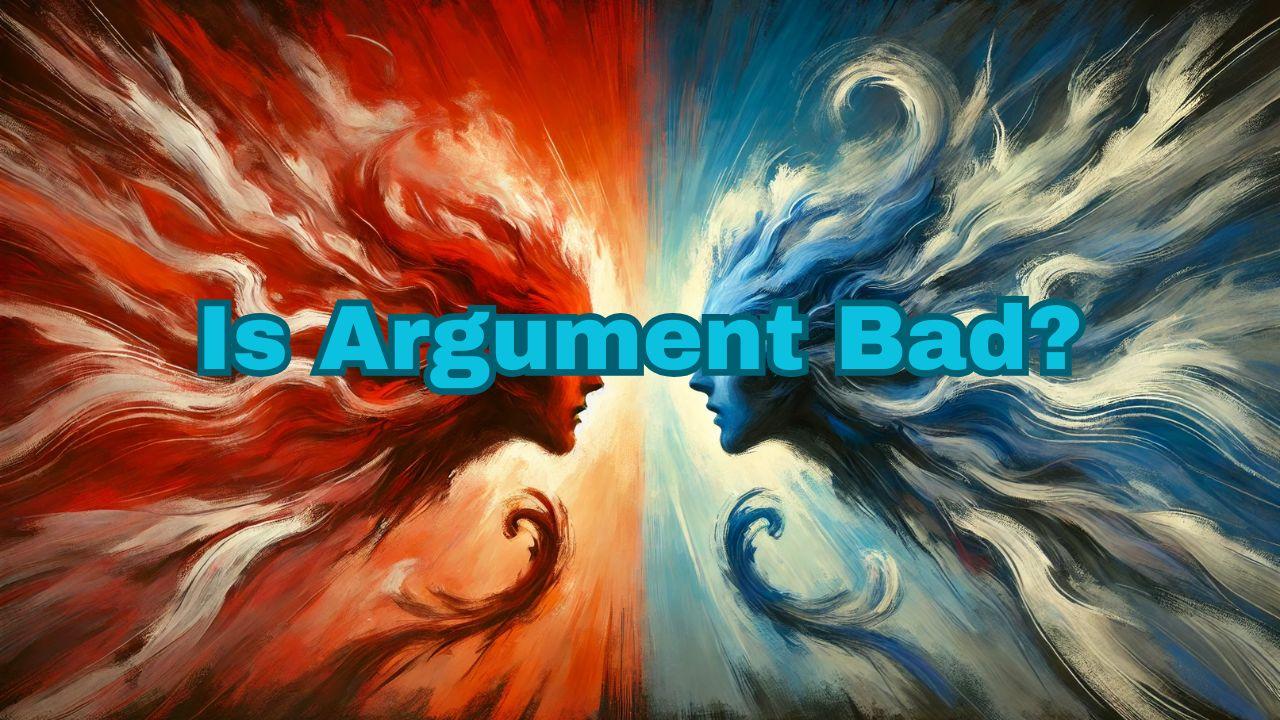
Is Argument Bad?#
In this talk I will discuss with about “Argument”
People think Argument is bad.
You can think, and ask yourself,
Is Argument really bad?
We will discussed that here.
An argument is a structured series of
sentences, statements, or propositions,
where some serve as premises leading to a conclusion.
This logical framework is not just confined
to philosophy or debate but is also fundamental to both
scientific inquiry and spiritual exploration.
In the scientific process, an argument begins with a hypothesis—
a proposed explanation or assumption about reality.
To test its validity, we put forward statements and reasoning,
conduct experiments, gather data,
and engage in analysis.
The argument is then refined through discussion and debate,
ensuring that the conclusion is
backed by empirical or logical support.
Discussion, on the other hand, is different.
It occurs when there is already an established
understanding of a subject.
There is no hypothesis to test and
no argument to build—only an exchange of
knowledge, clarification, or elaboration.
In Indian Hindu tradition, if we ask ourself
What “Adishankara” was doing when he was traveling
across the length and width of Bharat?
Was he is discussing with other “Matha”
Schools of thoughts and Acharyas?
No, he was doing “Purva Paksha” of every school of thoughts
Then engaging with them with his answers.
There was hypothesis, there were arguments and
there were conclusions of those arguments.
Unfortunately, in society, the idea of “argument”
has been misunderstood and often carries a negative connotation.
Many people engage in verbal fights
rather than true arguments
because they lack a clear hypothesis
or a logical basis for discussion.
Instead of systematically seeking the truth,
they argue emotionally, leading to
pointless disputes that go in circles.
This is not argumentation—it is chaos.
However, arguments between serious
and intellectual individuals
who are genuinely seeking the truth are beneficial.
They refine perspectives, challenge assumptions,
and lead to deeper understanding.
When fools argue, however,
they have nothing to establish except
their own stubbornness, emotional outbursts,
and sometimes even physical aggression.
Instead of engaging in meaningful debate,
they resort to madness and violence,
making the entire exchange ugly and unproductive.
True argumentation is a tool for discovery,
reasoning, and progress.
But for it to be fruitful,
it requires clarity, rationality, and an openness to the truth—
not just the desire to win at any cost.
O Chaitnya, I hope got some clarity
around “Argument” and now it will help you
arguing with wise person
and avoiding argument with fools.
Hari Om Tat Sat
Yours Truly Hari

Comments: