
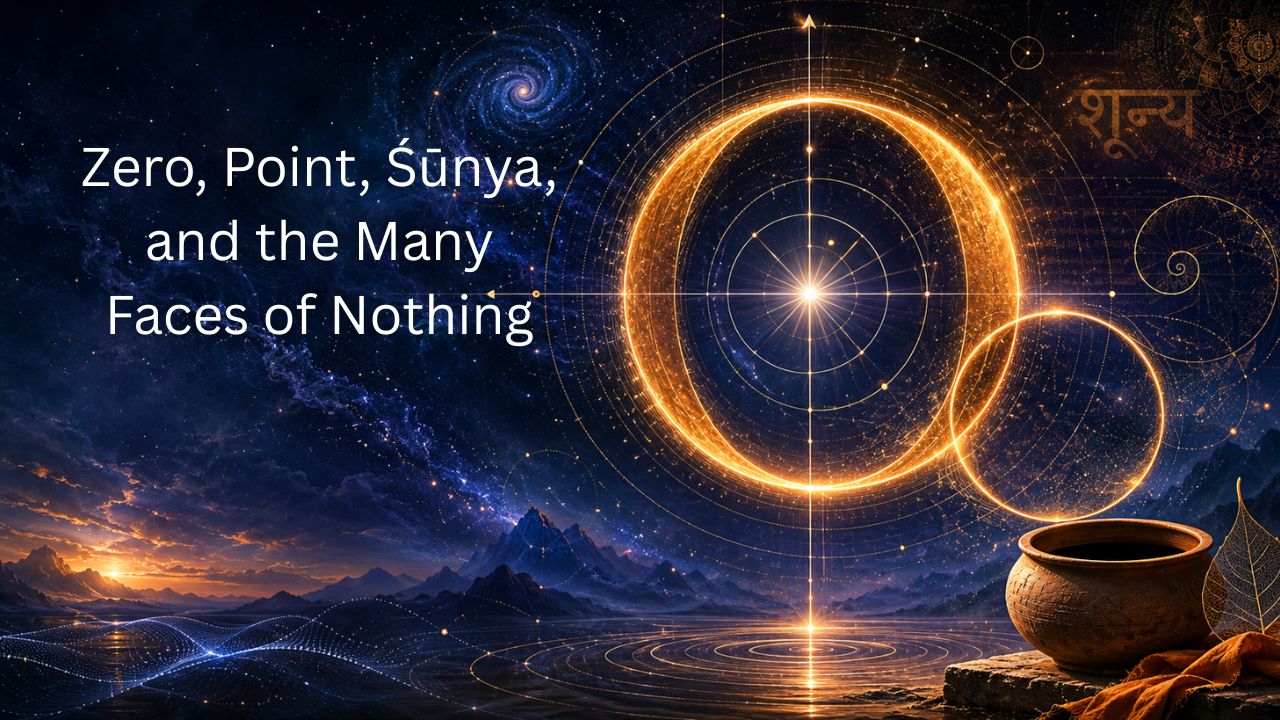
Almost ten years later, I reflect here again on Śūnya and Zero — revisiting the question from the 2016 article.
Zero, Point, Śūnya, Nothingness, Emptiness, Vacuum, Abhāva and Absence#
A Philosophical Inquiry into the Many Faces of “Nothing”#
Human beings live among things. We see bodies, trees, rivers, stars, houses, tools, people, emotions, events, and memories. Our language is built around objects. Our survival depends on recognizing objects: food, danger, shelter, friend, enemy, boundary, distance, ownership, loss, gain.
But when thought becomes subtle, it begins to ask a strange question:
What is the meaning of “nothing”?
At first this appears to be a simple question. Nothing means no thing. Zero means no quantity. A point means no size. Empty space means nothing is there. A vacuum means absence of matter. Śūnya means emptiness. Abhāva means absence or non-existence.
But when we look carefully, these are not the same. They belong to different domains of understanding: mathematics, geometry, physics, logic, language, metaphysics, spirituality, and lived experience. Yet they are connected by one deep intuition: reality is not exhausted by visible things. Absence also has structure. Emptiness also has meaning. Nothingness is not always mere negation; sometimes it is the silent condition that allows something to appear.
This article is an attempt to bring together several related concepts: zero, point, śūnya, nothingness, emptiness, vacuum, abhāva, absence, and the strange status of “no thing” in human understanding.
1. The Human Mind and the World of Things#
The ordinary mind is object-oriented. It does not first perceive reality as fields, probabilities, relations, or abstractions. It perceives things.
A child sees a ball, not a spherical object occupying a region of spacetime. A farmer sees a field, not a distribution of molecules and electromagnetic interactions. A person sees a table, not mostly empty atomic structure held together by quantum forces.
This object-based perception is not a defect. It is necessary for survival.
To live, we must distinguish:
- edible from poisonous,
- safe from dangerous,
- near from far,
- mine from yours,
- body from world,
- presence from absence.
Therefore, the mind converts the flowing complexity of reality into stable objects. It gives boundaries to what may not have sharp boundaries. It gives names to processes. It treats patterns as things.
This is useful. But philosophy begins when we ask:
Are the boundaries we perceive ultimately real, or are they useful constructions?
This question brings us to zero, point, emptiness, and absence.
2. Zero: Empty Quantity#
Zero is one of the most powerful ideas ever created by the human mind.
In ordinary language, zero means nothing. But mathematically, zero is not simply nothing. Zero is a number. It is an object in the system of arithmetic. It participates in operations. It has rules.
Five minus five is zero. Zero plus five is five. Five multiplied by zero is zero. Zero is the additive identity.
So zero is not mere blankness. It is a precise symbol for empty quantity.
When we say:
0 bananas = 0 apples
we do not mean bananas and apples are the same objects. We mean the quantity is the same: none. At the level of quantity, the difference between bananas and apples disappears when both are absent.
This is philosophically profound.
When there are five bananas and five apples, difference remains. Bananas are not apples. But when there are zero bananas and zero apples, the arithmetic distinction collapses into a common absence.
Zero therefore performs a strange operation: it removes the particularity of things and reveals pure quantity as absence.
Zero is not a thing in the world like a stone or a tree. Yet without zero, modern mathematics, accounting, computing, physics, engineering, and digital civilization would be impossible.
So zero is not “nothing” in a useless sense. It is a meaningful nothing.
It is the number that represents the absence of countable things.
3. The Point: Empty Extension#
If zero is empty quantity, the mathematical point is empty extension.
A point has location but no size. It has no length, no width, no height. In geometry, it is not a tiny dot. A dot drawn by a pen has thickness. A hole made by a needle has radius. A pixel on a screen has area. But a mathematical point has no area at all.
This is difficult for the imagination because every visible “point” in the physical world has some dimension. A black dot on paper is only called a point because it is small relative to the page. Under a microscope, it becomes a patch of ink.
So there are two kinds of “point”:
- Mathematical point — pure location without size.
- Physical point — a small region treated as a point for practical purposes.
This distinction is very important.
When physics says an electron is “point-like,” it does not mean the electron is literally a tiny ink dot. It means no internal spatial structure has been detected. It behaves, in some contexts, as if it has no measurable radius.
Here the mathematical concept of a point enters physical theory. But physical reality never directly gives us a perfect mathematical point. Every measurement has limits. Every detector has resolution. Every physical mark has size.
A point, therefore, is not a physical object. It is an idealization.
Yet this idealization allows us to build geometry, calculus, physics, maps, architecture, and engineering. The point has no size, but it gives structure to space.
Zero is empty quantity. Point is empty extension.
Both are “nothing-like,” but they are not the same nothing.
4. Śūnya: Emptiness Beyond Mere Nothing#
The Sanskrit word śūnya is often translated as zero, void, empty, or nothing. But this translation can mislead us.
In mathematics, śūnya became associated with zero: the absence of quantity. But in philosophical traditions, especially Buddhism and several streams of Indian thought, śūnya or śūnyatā carries a much deeper meaning.
Śūnya does not always mean that nothing exists. It often means that things do not exist independently, permanently, and self-sufficiently.
A clay pot exists. But does it exist independently?
It depends on clay, potter, wheel, space, fire, water, name, use, perception, and context. Break the pot and the “pot” disappears, though clay remains. Was the pot absolutely real? Was it unreal? Or was it dependently real?
Śūnyatā points toward this dependent nature of things.
Things exist, but not as isolated, self-standing entities. They arise through relations. They are empty of independent essence.
This is very different from saying, “Nothing exists.”
It is closer to saying:
Everything exists relationally, conditionally, dependently.
A wave is empty of independent existence because it is not separate from the ocean. Yet the wave is not simply non-existent. It can rise, move, crash, and disappear. Its form is real at one level, but not ultimately independent.
Similarly, a person, a body, a thought, a nation, a company, a language, a memory, and even an identity exist in a dependent way. They are real as patterns, but empty of absolute self-existence.
In this sense, śūnya is not a dead void. It is the openness of reality in which forms arise and dissolve.
5. Nothingness: The Problem of “No Thing”#
Nothingness is perhaps the most difficult concept among all.
When we say “nothing,” we usually mean no thing is present. But the moment we speak of nothing, we seem to make it into something. We name it. We think about it. We refer to it.
This creates a paradox:
If nothing is truly nothing, how can we speak about it?
Language turns absence into an object of thought. We say, “There is nothing in the box.” But what is “there”? What is the “nothing” that is in the box?
Strictly speaking, there is not a thing called nothing inside the box. Rather, the expected object is absent.
This means many uses of “nothing” actually mean absence relative to expectation.
If I say, “There is nothing on the plate,” I do not mean there is no air, no atoms, no space, no light, no gravitational field. I mean there is no food.
If I say, “There is nothing in the room,” I may mean no furniture, no people, or nothing important. But physically, the room still contains air, radiation, fields, dust particles, and spacetime.
So nothingness is often contextual. It depends on what we expected to find.
This is why absolute nothingness is so hard to conceive. Every time we imagine it, we imagine darkness, empty space, silence, or blankness. But darkness is not nothing. Space is not nothing. Silence is not nothing. Blankness is not nothing. They are still forms of experience.
Absolute nothingness would mean no objects, no space, no time, no laws, no observer, no possibility of distinction.
But such nothingness cannot be experienced, because experience itself is already something.
6. Emptiness: Absence That Allows Presence#
Emptiness is not always negative. In many cases, emptiness is useful, necessary, and creative.
A cup is useful because it is empty inside. A room is useful because it has empty space. A road is useful because it is open. A pause in music gives rhythm. A silence in speech gives meaning. A blank page allows writing. An empty mind can receive insight.
This shows that emptiness is not merely lack. Emptiness can be a condition of possibility.
The hole in a flute is not a defect. It produces music. The empty space in a house is not useless. It makes dwelling possible. The gap between words is not meaningless. It allows language to be understood.
Therefore, emptiness has two faces:
- Negative emptiness — absence, loss, lack, deprivation.
- Creative emptiness — openness, space, possibility, receptivity.
This distinction is important in both philosophy and life.
An empty stomach may be suffering. An empty schedule may be freedom. An empty mind may be dullness, or it may be meditation. An empty field may be barren, or it may be ready for cultivation.
Emptiness is not one thing. Its meaning depends on context.
7. Vacuum: The Physical Emptiness That Is Not Empty#
In physics, a vacuum is often described as empty space. But modern physics has made this idea complicated.
A classical vacuum means a region with no matter. Remove air, dust, and particles from a container, and we call it a vacuum.
But in quantum field theory, even the vacuum is not absolute nothingness. It is the lowest-energy state of fields. It is not filled with ordinary particles, but it is not a philosophical void.
Fields still exist. Quantum fluctuations may occur. Physical laws still operate. Space and time still provide structure. The vacuum has properties.
Thus, the physical vacuum is not “nothing.” It is a condition in which ordinary matter is absent but the deeper structure of physical reality remains.
This is another crucial distinction:
Vacuum is not absolute nothingness. Vacuum is the absence of matter within the presence of spacetime and fields.
A vacuum can have energy. It can be affected by gravity. It can participate in physical phenomena. It is measurable.
So the vacuum is empty only in a qualified sense. It is empty of particles, not empty of reality.
This means physics does not actually deal with absolute nothingness. Physics studies states, fields, laws, relations, and measurable effects. Even its “nothing” is structured.
8. Abhāva: Absence as a Knowable Reality#
In Indian logic and philosophy, especially Nyāya-Vaiśeṣika traditions, abhāva means absence or non-existence. But this absence is not treated casually. It is analyzed carefully.
Suppose there is no pot on the floor. We know the absence of the pot. This is not merely ignorance. It is a valid cognition: “The pot is not here.”
This is powerful. It means absence can be known.
Abhāva is not the same as absolute nothingness. It is always absence of something in some locus.
No pot on the floor. No water in the glass. No sound in the room. No answer in the document. No pain in the body. No fear in the mind.
Absence has structure:
- What is absent?
- Where is it absent?
- When is it absent?
- For whom is it absent?
- Relative to what expectation is it absent?
This makes abhāva deeply analytical.
If I say, “There is no elephant in this room,” the absence is meaningful because elephant is a possible object of thought and this room is a possible location. But if I say, “There is no square circle in this room,” the statement is different because a square circle is logically impossible.
So absence is not always simple. There is absence of an actual thing, absence of a possible thing, absence of an expected thing, and absence of an impossible thing.
Indian philosophers recognized that non-existence is not a blank category. It has types and conditions.
This is a major contribution to the philosophy of nothingness.
9. Absence: The Everyday Experience of Nothing#
Absence is the most human form of nothingness.
We experience absence when someone is not present, when a sound stops, when a loved one dies, when a memory fades, when a possibility is lost, when an expected message does not arrive.
This kind of absence is not abstract. It is felt.
An empty chair at the dining table is not just empty space. It may be full of memory. The absence of a person can be more powerful than the presence of many objects.
This shows that absence is not emotionally neutral.
In human life, absence can have weight.
A missing word can change the meaning of a sentence. A missing signature can stop a contract. A missing heartbeat can end a life. A missing person can fill an entire house with silence.
Here nothingness becomes existential.
The absent thing is not there physically, yet it shapes experience. This means absence can be causally and psychologically powerful.
The person is absent, but grief is present. The sound is absent, but silence is present. The object is absent, but expectation remains.
Thus, absence is not merely non-being. It is non-being recognized by consciousness.
10. The Electron and the Question of Size#
Modern physics gives us a strange example. The electron has mass, charge, spin, and magnetic moment, but it may not have size in the ordinary sense.
This challenges everyday thinking.
We normally assume that if something exists, it must occupy space like a tiny ball. But fundamental particles do not behave like small versions of everyday objects. An electron is not a little marble. It is better understood as a quantum entity, or in quantum field theory, an excitation of the electron field.
When measured, it appears as a localized event. But between measurements, it is described by a wavefunction. The probability cloud is not a physical fog in the ordinary sense; it is a description of where the electron may be detected.
So the electron raises a deep question:
Can something have properties without having size?
Modern physics says yes.
Mass does not necessarily require volume. Charge does not necessarily require surface. Spin does not necessarily mean literal rotation like a spinning ball.
This means that our everyday idea of a thing as “an object with size” is not fundamental. It is an emergent concept suitable for medium-sized objects like stones, bodies, and tools.
At the deepest physical level, reality may not be made of tiny objects with clear boundaries. It may be made of fields, excitations, relations, probabilities, and interactions.
If that is so, then “size” is not an illusion, but it may be emergent.
A table has size. A planet has size. A body has size. But their size arises from deeper structures that may not themselves have size in the same way.
This is similar to temperature. A cup of tea has temperature, but a single molecule does not have temperature in the same everyday sense. Temperature emerges from collective behavior.
Likewise, size may emerge from patterns of interaction.
11. Is Size a Fiction of the Mind?#
If fundamental entities may not have size, should we say that nothing in the world really has size?
Not exactly.
Size is not fiction in the sense of being false. A door has a width. A person has height. A road has length. These are measurable and practically real.
But size may be a scale-dependent reality.
At the human scale, size is real. At the atomic scale, solidity becomes mostly electromagnetic interaction. At the quantum scale, position and extension become subtle. At the Planck scale, even the meaning of distance may break down.
So size is real, but not necessarily fundamental.
This distinction is important:
Real does not always mean fundamental.
A rainbow is real, but it is not a solid object. A wave is real, but not separate from water. A company is real, but not a physical particle. A traffic jam is real, but not an independent substance. A nation is real, but its borders exist through agreement, power, memory, and law.
Similarly, size is real as an emergent feature of the world we inhabit.
The mind did not invent size from nothing. But the mind organizes reality into bounded objects because that is useful for action and survival.
Thus, size is not pure illusion. It is a functional interpretation of reality.
12. Nothingness and Consciousness#
All these concepts—zero, point, śūnya, vacuum, absence—become meaningful only in relation to consciousness or cognition.
Zero is known by a mind that counts. Point is conceived by a mind that abstracts location. Absence is recognized by a mind that expects presence. Vacuum is measured by instruments and interpreted by theory. Śūnya is contemplated by insight. Nothingness is questioned by awareness.
Without consciousness, can there be absence?
Physically, yes: there may be no pot on the floor whether or not anyone notices it. But the knowledge of absence requires cognition.
Absence becomes meaningful when it is recognized.
This is why absence plays such a deep role in human life. We do not merely encounter objects; we also encounter missing objects, lost possibilities, silence, gaps, pauses, and endings.
Consciousness does not only reveal presence. It also reveals absence.
In fact, some traditions suggest that consciousness itself is most clearly recognized when mental objects become quiet. When thoughts, desires, fears, and memories settle, what remains?
Not blank nothingness, but awareness.
This leads to a subtle distinction:
- Empty mind does not mean non-existence.
- Silence does not mean unconsciousness.
- Stillness does not mean deadness.
- Śūnya does not necessarily mean nihilism.
There may be an emptiness that is not absence of reality but absence of clutter.
13. The Difference Between Nihilism and Emptiness#
A common misunderstanding is to equate emptiness with nihilism.
Nihilism says: nothing matters, nothing has value, nothing is real.
Śūnya or philosophical emptiness does not necessarily say this. It says things lack independent, permanent, self-existing essence. But this does not destroy meaning. It may actually deepen compassion and wisdom.
If the self is not isolated, then my life is connected with others. If things are impermanent, then attachment must be understood carefully. If forms are dependent, then responsibility becomes more important, not less. If identity is constructed, then transformation is possible.
Emptiness does not have to lead to despair. It can lead to freedom.
A rigid self suffers because it clings to fixed identity. A fluid self can learn, adapt, forgive, and awaken.
A rigid concept of reality breaks when reality changes. An empty concept can remain open.
Thus, emptiness is not meaninglessness. It is freedom from false solidity.
14. The Many Kinds of “Nothing”#
We can now distinguish different meanings of nothing:
Zero is nothing as quantity. It answers: how many?
Point is nothing as extension. It answers: where, without size?
Empty set is nothing as membership. It answers: what elements are contained?
Vacuum is nothing as absence of matter. It answers: what physical stuff is present?
Abhāva is nothing as absence of a particular thing in a particular locus. It answers: what is not there?
Śūnya is nothing as emptiness of independent essence. It answers: does anything exist by itself?
Nothingness is the radical negation of all things. It asks: what if there is no thing at all?
Silence is absence of sound. Darkness is absence of visible light. Stillness is absence of motion. Peace may be absence of inner conflict. Freedom may be absence of bondage. Death may be absence of life in a body. Mokṣa or nirvāṇa may be understood by some traditions as absence of ignorance, craving, or bondage.
Therefore, “nothing” is not one concept. It is a family of concepts.
Every nothing has a hidden question behind it:
Nothing of what? Nothing where? Nothing when? Nothing for whom? Nothing in what sense? Nothing relative to what expectation? Nothing as measured by what method? Nothing at what level of reality?
Without these questions, “nothing” remains vague.
15. The Ontology of Absence#
Ontology asks: what exists?
At first, it seems only presence exists. A chair exists. A tree exists. A body exists. A star exists.
But absence also affects reality.
A missing bridge changes a journey. A missing law changes society. A missing gene changes a body. A missing memory changes identity. A missing trust changes a relationship. A missing boundary changes behavior. A missing zero changes mathematics.
Absence may not be a thing, but it can be real in its consequences.
This suggests a subtle principle:
Not everything real is a thing.
Relations are real. Patterns are real. Absences are real. Possibilities are real in a different way. Laws are real in a different way. Meanings are real in a different way.
The world is not made only of objects. It is also made of relations, structures, gaps, limits, potentials, and absences.
This is why a purely object-based worldview is incomplete.
16. The Creative Power of the Void#
Many creation stories begin not with a thing, but with a kind of emptiness: darkness, waters, void, silence, unmanifest reality, pure potential.
This symbolism appears across cultures because human beings intuit that form emerges from the formless.
A seed seems empty compared to a tree, yet the tree arises from it. A blank page seems empty, yet a book can arise from it. A silent mind seems empty, yet insight can arise from it. A pause in conversation seems empty, yet understanding can arise from it.
The unmanifest is not always nothing. Sometimes it is potential not yet expressed.
This is different from zero quantity. It is more like latent possibility.
In Sanskritic thought, one may distinguish between absolute non-existence and the unmanifest. The unmanifest is not yet a formed object, but it is not sheer nothing. It is a causal or potential condition.
This distinction is vital.
A tree is absent in the seed as a visible tree, but not absent as potential. A poem is absent on the blank page as written words, but not absent from the poet’s mind as possibility. A sculpture is absent in the stone as finished form, but not absent to the sculptor’s vision.
Thus, emptiness may be womb-like, not merely void-like.
17. Zero and Infinity: Two Doors Beyond Ordinary Quantity#
Zero and infinity are opposite in one sense, but related in another. Both challenge ordinary counting.
Zero is less than every positive number. Infinity is greater than every finite number. Zero suggests absence. Infinity suggests boundlessness.
Yet both break the mind’s ordinary habit of dealing with manageable quantities.
In spiritual and philosophical language, the absolute is sometimes described through both negation and infinity.
Neti neti: not this, not this. Ananta: endless, infinite. Śūnya: empty. Pūrṇa: full.
This creates an apparent paradox:
How can ultimate reality be empty and full?
The famous idea of pūrṇa says fullness remains fullness even when fullness appears from it. Śūnya says forms are empty of independent essence. These are not necessarily contradictions. They may be two ways of pointing beyond object-based thinking.
From the standpoint of separate things, emptiness means lack. From the standpoint of the whole, emptiness may mean openness. From the standpoint of ego, nothingness is frightening. From the standpoint of wisdom, emptiness may be freedom.
18. A Unified View#
Let us now bring the concepts together.
Zero teaches that absence can be mathematically exact. Point teaches that location can exist without extension. Śūnya teaches that things may exist without independent essence. Vacuum teaches that physical emptiness is still structured. Abhāva teaches that absence can be known and classified. Nothingness teaches the limit of thought and language. Emptiness teaches that absence can be creative. Human experience teaches that what is absent can still shape life.
Together, these concepts show that “nothing” is not simple.
There is no single nothing.
There is mathematical nothing, geometrical nothing, physical nothing, logical nothing, existential nothing, spiritual emptiness, and practical absence.
The deepest insight may be this:
Nothingness is not merely the opposite of being. It is one of the ways through which being becomes intelligible.
We understand presence through absence. We understand sound through silence. We understand form through space. We understand quantity through zero. We understand location through the point. We understand existence through non-existence. We understand self through the possibility of selflessness.
Nothing is not just what is missing. It is also what allows distinction, meaning, measurement, and manifestation.
19. Conclusion: The Wisdom of Emptiness#
The journey from zero to śūnya is a journey from counting to contemplation.
At the mathematical level, zero is a number. At the geometrical level, point is location without size. At the physical level, vacuum is not absolute nothing but a structured state. At the logical level, abhāva is knowable absence. At the existential level, absence is felt. At the spiritual level, emptiness can become freedom.
The ordinary mind fears nothingness because it is attached to things. But deeper inquiry reveals that every thing depends on some form of no-thing.
A pot needs empty space. A word needs silence. A form needs background. A number system needs zero. A geometry needs points. A self needs openness to change. A mind needs inner space to know truth.
Therefore, emptiness is not merely the denial of reality. It is one of reality’s deepest dimensions.
The human mind creates boundaries for survival, and these boundaries are useful. But wisdom begins when we see that boundaries are not absolute. Things are real, but relational. Forms appear, but they are not independent. Absence is not a useless blank; it is woven into the fabric of meaning.
Zero is not a mere nothing. A point is not a tiny dot. Vacuum is not absolute void. Śūnya is not nihilism. Abhāva is not ignorance. Absence is not always weakness.
The deepest nothing may not be dead emptiness, but living openness.
And perhaps this is why the inquiry into nothingness is never merely negative. It does not end in despair. It opens into subtlety.
When we understand nothing properly, we understand something more deeply.
Also in this series: Hans Peter Dürr and Vedanta; Quantum Physics and Vedanta. Next: Roadmap to Reality (Part 6).

Comments: